 Moonwell
 borrowing acceptance signals and incomplete state checks
Moonwell borrowing reaches completion when the transaction executes successfully, corresponding debt appears on the connected account and the requested asset arrives in that wallet. A signature or pending transaction doesn't prove acceptance. If those records disagree, identify the missing state before trying again. Collateral eligibility, available credit, market liquidity and the borrow cap can each explain why a request remains incomplete.
A successful receipt, matching debt record and wallet balance distinguish a completed Moonwell borrow from a request that needs another check.
A completed borrow changes the account immediately
One accepted borrow creates an outstanding obligation and reduces the account's remaining credit. It also transfers the borrowed asset from the selected market to the connected wallet. Those changes distinguish an executed loan from a quote, a signed request or an unresolved transaction.
The position starts accruing interest after execution. Collateral values, borrowed values and market parameters may then change the account's borrowing margin even when the user submits no further transaction. Acceptance therefore matters beyond the initial transfer: it starts an active debt position that must remain adequately collateralized.
Before execution, the supplied asset must be enabled as eligible collateral and the account must have enough credit for the requested amount. The selected market also needs available liquidity and room under its borrow cap. A pause or insufficient network gas can stop the transition before any debt is created.
Three records establish the accepted state
Receipt status
A transaction hash identifies the request but doesn't prove that it was included or succeeded. Read the final receipt on the intended network and confirm that it belongs to the connected account. A successful status is the first evidence that the borrow call executed rather than reverted.
Wallet asset balance
After successful execution, Moonwell sends the borrowed asset to the connected wallet. The wallet's visible asset list may not update at once, so compare the actual token balance for the same account and network. A hidden token display shouldn't be mistaken for a failed transaction.
Debt and credit record
The market position should show the new borrowed amount, while credit remaining should fall to reflect the obligation. If the asset balance changed but no debt appears, refresh the account data and verify the connected address before taking another action. A second borrow isn't a safe diagnostic test.
Pending, failed and successful transactions need different treatment
Pending execution
A pending request has no final outcome. Market conditions and the account state can continue changing while it waits. Avoid submitting the same borrow again merely because the interface appears stuck, since both requests could execute if each becomes a valid transaction.
Reverted execution
A reverted receipt means the borrow didn't create the intended debt or deliver the asset. Recheck the failure against live credit, collateral status, liquidity, borrow-cap room, pauses and the wallet's gas balance. Correct the identified condition instead of repeating an unchanged request.
Successful execution
A successful receipt calls for reconciliation, not another borrow. Match the transaction to the intended account, then inspect its debt position and asset balance. If the interface still shows the earlier state, treat that as a display or indexing mismatch until the onchain records show otherwise.
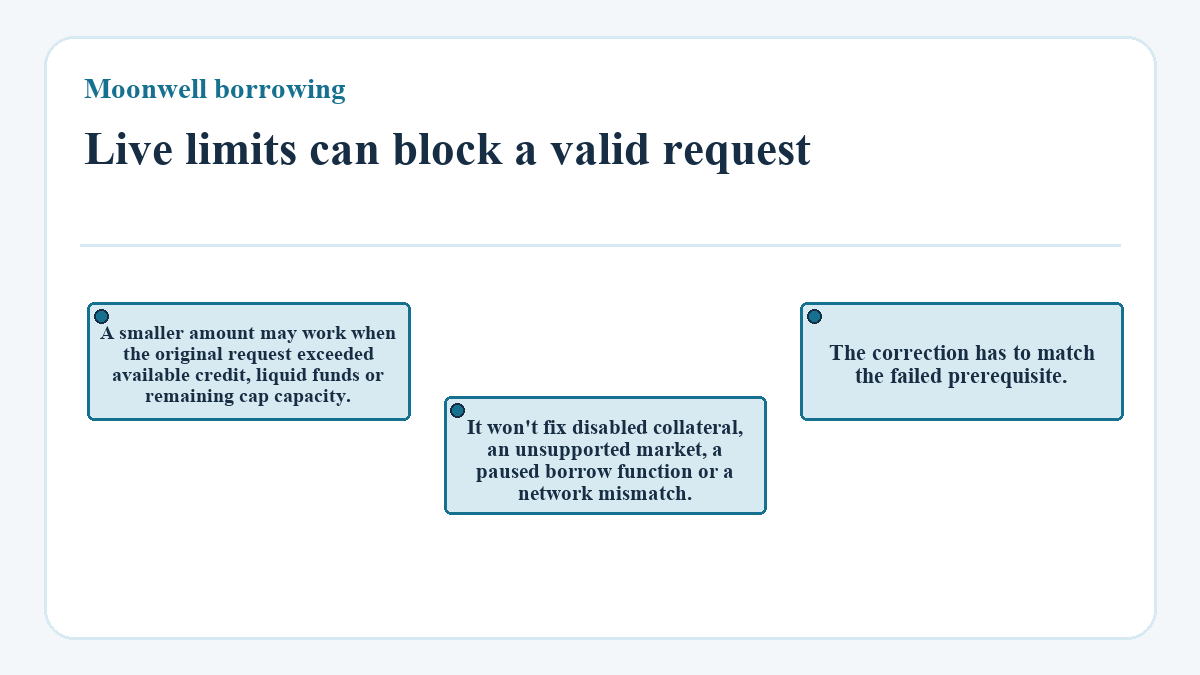
Live limits can block a valid request
Four independent constraints can stop an otherwise well-formed borrow. Available credit limits what the account can support. Market liquidity limits what can leave the pool, while the borrow cap limits aggregate borrowing. A protocol pause can block the action regardless of the other values.
A smaller amount may work when the original request exceeded available credit, liquid funds or remaining cap capacity. It won't fix disabled collateral, an unsupported market, a paused borrow function or a network mismatch. The correction has to match the failed prerequisite.
A collateral factor of zero means that supplied asset contributes no borrowing capacity. It doesn't by itself explain every rejected request, because the target market's liquidity and borrow cap remain separate. Read each control in its own scope rather than collapsing them into one maximum figure.
Credit remaining measures the position after acceptance
Credit remaining equals the collateral-based credit limit minus the account's borrowed value. Each enabled collateral position contributes according to its market's collateral factor. Borrowing reduces the result, while repayment or additional eligible collateral can increase it.
A positive value doesn't guarantee that another borrow will execute. The target market may lack liquidity, have no room beneath its cap or have borrowing paused. Conversely, a successful transaction can leave little margin even though it stayed within the displayed limit when submitted.
Interest accrual and collateral price changes can reduce credit remaining after acceptance. If it reaches the liquidation boundary, collateral may be seized to repay debt. The displayed borrowing rate is variable, so a rate seen at confirmation isn't a fixed cost for the life of the position.
One mismatch separates waiting from correction
For a time-sensitive borrow, compare the expected state with the state that can actually be observed. The expected state is a successful receipt, a larger wallet balance for the borrowed asset and a matching debt record. Elapsed time alone can't establish any of those outcomes.
If the receipt remains pending, keep watching that transaction for a final status instead of submitting another borrow. If it reverted, revisit the live prerequisite that blocked execution. If it succeeded but one display remains unchanged, reconcile the account and token records before deciding that anything needs to be retried.
A bounded recheck comes before another submission
Use one short pass through the records and live constraints before changing the request:
- Read the final receipt status rather than relying on the presence of a transaction hash.
- Confirm that the connected address and active network match the submitted transaction.
- Check that eligible collateral remains enabled and that the account still has available credit.
- Compare the requested amount with current liquidity and remaining borrow-cap capacity.
- After success, confirm that the wallet received the borrowed asset, new debt appears and credit remaining falls.
When a specific constraint caused the failure, adjust only what that constraint requires. Reducing the amount can address limited capacity, but it can't repair a network mismatch or paused market. Stop if the receipt and account records can't be reconciled, since another submission could add debt rather than clarify the first request.
Display gaps don't always mean the borrow failed
Wrong network view
A wallet can show the connected account on a different network from the completed transaction. In that state, the expected asset may appear absent even though execution succeeded elsewhere. Match the network recorded by the transaction before judging the wallet balance.
Hidden or unrecognized token
Some wallets don't place every received token in the main asset list automatically. Check the balance for the exact token contract used by the market. Never select a contract by ticker alone, since a familiar symbol doesn't establish token identity.
Delayed interface data
The account interface may briefly retain cached position data after a confirmed transaction. Refreshing the correct account can resolve that presentation gap. Until it does, the final receipt and onchain account state provide stronger evidence than a stale button, spinner or portfolio total.
Repayment reduces or closes an accepted borrow
Once execution succeeds, disconnecting the wallet or rejecting a later prompt won't cancel the debt. Repayment is the action that reduces it. The repayment transaction must use the appropriate borrowed asset and execute successfully before the account record can change.
Adding collateral may improve credit remaining, but it doesn't remove the borrowed obligation. Repaying debt addresses the liability directly. After repayment, compare the new debt balance and remaining credit with the successful receipt instead of assuming that a submitted request reached completion.
If the original borrow was larger than intended, don't treat the position as incomplete merely because the amount was unwanted. It is still an accepted borrow when the receipt, wallet transfer and debt agree. Repay the excess or the full balance.
Time sensitivity follows the live account state
No fixed waiting period proves that a borrow succeeded or failed. Confirmation timing depends on network execution, while borrowing capacity depends on live collateral values, interest, liquidity and governance-controlled parameters. An earlier quote or screenshot can't establish the outcome of a later request.
The answer changes when the final receipt changes. A failed receipt leaves the borrow incomplete and calls for a targeted correction. A successful receipt with matching debt and asset records establishes acceptance, even when one interface view takes longer to catch up.
Quick answers about Moonwell borrowing
Can a reverted Moonwell borrow still use network gas?
Yes. A reverted transaction can consume network gas because the network executes it until the revert, even though the borrow creates no debt and delivers no asset. Check the transaction record for the failed status and gas fee. Before retrying, identify whether credit, collateral status, liquidity, borrow-cap capacity, a pause or another prerequisite caused the revert. Repeating the same request can spend more gas without changing the outcome.
Does collateral need to be enabled again after a failed borrow?
Not if the separate collateral-enabling transaction succeeded and the asset remains enabled for that account. A later borrow failure doesn't normally reverse an already completed collateral setting. Check the live account state before repeating that authorization. If the collateral transaction itself failed, or if the setting was later disabled, the account won't receive borrowing capacity from that asset until a valid enabling transaction executes.
Why can the maximum borrow amount change before confirmation?
The maximum can move because collateral values, accrued interest, existing debt and market conditions are live inputs. Available liquidity or remaining room under the borrow cap may also change between opening the form and executing the transaction. Treat the displayed amount as a current calculation rather than a reservation. If the request later fails, re-read the updated constraints and choose an amount that the account and market can support.
Do I need token approval before Moonwell sends a borrowed asset?
Receiving the borrowed asset doesn't normally require an ERC-20 spending allowance for that asset. An allowance authorizes a contract to transfer tokens out of a wallet, which is a different action. Moonwell borrowing still requires eligible supplied collateral, collateral enablement, sufficient credit and network gas. A later repayment with a token may require its own approval before the repayment transaction can transfer that asset from the wallet.
Is there a fixed repayment date after a Moonwell borrow succeeds?
Moonwell borrows don't have a fixed maturity date. They can remain open while the account stays above its liquidation boundary. Interest continues to accrue, so leaving the debt open can reduce credit remaining over time. Collateral price changes can also alter the margin without another transaction. A missing calendar deadline therefore doesn't mean the position can be ignored. Monitor the debt, variable rate, collateral value and remaining credit for as long as it stays open.
Can collateral be disabled while debt remains open?
The account can't remove collateral support when doing so would leave its active debt without enough borrowing capacity. Repaying part of the debt or adding other eligible collateral may create room to disable the original asset later. A submitted collateral change isn't complete until its transaction succeeds. If it reverts, the existing collateral setting and debt position remain the states to use when assessing the account.
When does a partial repayment update the account state?
A successful partial repayment lowers the outstanding debt and usually increases credit remaining, but it doesn't close the borrow. Interest continues on the remaining obligation. Match the repayment receipt with the reduced debt balance before relying on the new margin. If the repayment is still pending or reverted, use the earlier debt amount when deciding whether another borrow, collateral change or withdrawal can proceed safely.
Can submitting the same borrow twice increase the debt?
Yes. If the first transaction succeeded and the retry is a separate valid transaction, both can execute and increase the account's debt. A stale interface or hidden wallet balance doesn't make the first request void. Check its final receipt, the borrowed asset balance and the account's debt before resubmitting. When the first transaction is still pending, another submission adds uncertainty unless the wallet deliberately replaces the original transaction.
Updated ·